Wednesday, 4 April 2012

Science-Art Communication Specialist - it's now a thing

Changed my LinkedIn profile to read "Science-Art Communication Specialist". I've decided that's now a thing.


Although painting and illustrating are my first choice in career and I'm busier than ever with commissions, when I consider my blog writing at Symbiartic on Scientific American, the growing number of talks, podcasts and interviews and my new volunteer Board Member position with Science Art-Nature this seems like a more apt description. I find myself doing a lot of networking for and with other artists engaged in science, and slowly starting to hear from scientists looking for artists. I've been seriously considering turning it into a consulting business. 


I've developed a standard email I send out to artists contacting me about their science-art and asking for advice since it's happening more and more often. (And I don't mind at all!
Keep 'em coming.)

Here's what it typically says.

- -
I've added your blog to the Science Artists Feed (It's in the 2nd list that feeds into the first one...the first one filled up fast).  So when you have a show or update the bloggy portion in any way, it will appear on the Feed to subscribers, and on scienceblogging.org which is a huge aggregator site many science bloggers turn to to follow the many science blogging networks. 


I don't know if it will help traffic or eyeballs in any way, but it also helps me to stay on top of people's work, which I irregularly compile interesting links from and put in posts I call Scumbles. They used to be on my personal blog The Flying Trilobite, and I've moved them to Symbiartic since Scientific American asked me on board. 


So far the biggest impact the Science Artists Feed and Scumble posts have had is drawing together the disparate scattered science-inspired artists into a tighter community.  I've shared a Circle on G+of them in the past and more are talking on Twitter. I just finished up at my 4th trip to ScienceOnline this year, in North Carolina. Usually I've been one of 2 or 3 science-artists or illustrators out of a few hundred researchers and science journalists.  This year, there were about a dozen of us in attendance which had an impact. If you're on Twitter, an easy way into the community there is to use the #scienceart hashtag. 
- -


(For the interactive version of the image above, head over to Symbiartic and explore the image!) 


- - - - - - - -

Original artwork on The Flying Trilobite Copyright to Glendon Mellow
under Creative Commons Licence.

Portfolio
Blog
Print Shop 

Find me on Symbiartic, the art+science blog on the new Scientific American Blog Network!

Tuesday, 3 April 2012

Inky Bidness

Coupla tattoo things. 

Fascinating personal post by paleo-author Brian Switek of Laelaps over at his other gig, Dinosaur Tracking, where he talks some more about the tattoo I designed for him not long ago. And hints at a second design possibly in the works. (I'm trying to see if it's possible to make a theropod's jaw open and close on Brian's flexing bicep.)

Check out his Allosaurus Ink, Brian has more recent, healed photos.  


Another tattoo I designed, the caffeine molecule for my SciAm peep Scicurious has long been one of my most popular all-time posts for getting traffic. Bound to happen then, that another internet denizen, Ryan S on Reddit has gotten a similar tattoo based on the design Sci and I came up with. 

Here it is on Scicurious:


I've also made a portfolio gallery of my science tattoo designs if you'd like to see more.


- - - - - - - -

Original artwork on The Flying Trilobite Copyright to Glendon Mellow
under Creative Commons Licence.

Portfolio
Blog
Print Shop

Find me on Symbiartic, the art+science blog on the new Scientific American Blog Network!

Monday, 2 April 2012

Important details

Came across a link with my name on it. 

Last year, I was pretty excited to start blogging at Scientific American. Around the same time, my university's alumni newsletter had sent an email asking for stories and entries, "where are they now" kind of features. Unlike many of my peers (and most people in post-secondary education) I'm actually still directly using a lot of the skills from my degree, though more for illustration than the fine art gallery-scene. 

So I sent in a little blurb about blogging for Scientific American. 

I didn't realize they actually published something. Here's the entry 


It reads, 


Mellow, Glendon (BFA Spec. Hons. Winters) is a graduate of York's Fine Arts Visual Arts studio program. He married Michelle Follett, a primary teacher for the TDSB, and they recently had their first child, Calvin. He is a speaker on the intersection of arts and science on several radio programs. 


Well yeah.  That's all true and a matter of public record. And being married to Michelle and having Calvin are two of the most amazing things in my life, certainly things I'm proud of. 

I dunno though, I sort of thought this was a newsletter for catching up with professional accomplishments? I guess it's like Facebook-old school. 

(And radio programs, but they left out podcasts?)

For those of you who love baby pictures, here's our little dynamo working at his art station, about 15 months old. 


- - - - - - - -

Original artwork on The Flying Trilobite Copyright to Glendon Mellow
under Creative Commons Licence.

Portfolio
Blog
Print Shop 

--> Find me on Symbiartic, the art+science blog on the new Scientific American Blog Network!

Thursday, 29 March 2012

Copyright Comfort Zone (repost)

(While thinking a lot about copyright over on Symbiartic, I thought I'd repost this piece from a couple of years ago.  Originally appeared May 2010 both here on The Flying Trilobite and at ART Evolved.) 
- -


In the past few posts of Going Pro, we've looked a lot at copyright. Again, a lot of people have opinions, but it's important to see what the legal definitions -and what steps you can take to protect your creations- really entail.

Today though, I want to propose a question.

Suppose you post a nifty image of a prehistoric critter online. It's awesome, you're proud, people give you kudos. You put it under a Creative Commons Licence, the most restrictive one that says your image a) must be attributed to you, b) cannot be altered, c) others cannot profit from it, and otherwise, it's okay to post and share.

1. Then someone copies it. Another blogger. Does their own riff. Are you okay with that?

2. What if they're more famous than you, getting lots of illustration gigs, but they notice it, do their own version, and give you a nod for your cool idea. Still excited, feeling the attention?

3. What if your painting happens to hit the zeitgeist and goes all viral all over the interwebs. Everyone is sharing it. There's a day on Facebook where all the users switch to you image. But you haven't made a dime.  What do you do?

We're in interesting territory. Personally, I don't believe overly restricting images (insanely huge watermarks, disabling right-clicking) are helpful to make a successful career anymore. But neither is completely open sharing.

Consider this:
[h/t Boing Boing]
It makes a strong case about question number 3, doesn't it? But how do you capitalize on that image going viral? How does it put food on the table?

I suggest it's how you parlay that viral dinosaur image into getting new contracts.

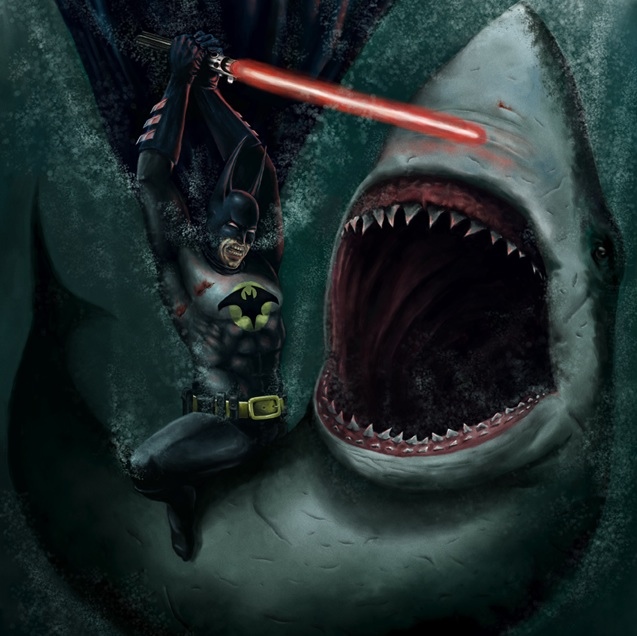
As for questions number 1 and 2, consider the post-modern, remixed, mash-up, variant-cover culture we live in. Think an Indiana Jones video game is fun? What about Indiana Jones Lego! Like Batman? Sharks? Lightsabers? Ta-da! (artist here) Authoring mash-ups and riffing on others' work is an integral part of pop culture.


Painting gets started at about the 4 minute mark in the video above.
[h/t to Boing Boing, again]

In the past, I've sometimes been the dissenting voice here at Art Evolved about all those posts showing past-art about upcoming themed galleries. I dislike them because sometimes attribution to the artwork cannot be easily found - though yes, as Peter and Craig have pointed out to me, sometimes we attribute an "orphan image" after the post goes up when a reader identifies it.

I'm uncomfortable with those posts because in a world of remixes and fun Photoshopped images, attribution and authorship can sometimes be your only coins to bank on. Literally.

Everyone has different comfort zones. Where do you feel comfortable with your images on questions 1-3 above?

- - - - - - - -

 Original artwork on The Flying Trilobite Copyright to Glendon Mellow
under Creative Commons Licence.

Portfolio
Blog
Print Shop 

--> Find me on Symbiartic, the art+science blog on the new Scientific American Blog Network!

Tuesday, 20 March 2012

Pinterest Terms of Service link round-up


After posting recently about Pinterest, I've been involved in a lot of discussion about their Terms of Service.  Here's a quick link primer to some of the discussions I'm involved in and I'm seeing in the science-art blogosphere.

To recap:

Pinterest does a lot of things right: links back to creator's sites, deleted pins get deleted on all subsequent re-pins - these are good things.

Pinterest has some problems: most people pin whatever neato things they find online when the Terms specifically state you must own the image or have permission. So it's built on misuse in many ways. Personally I think more artists should use Creative Commons type attitudes toward this type of sharing. But the point stands that most users violate Pinterest's own Terms of Service.

Pinterest has some Peril: they can "sell" and "otherwise exploit" all content according to their Terms of Service. So if you use it correctly, you're giving away your work which then involves risk assessment.

Read through these links to get the whole picture so far.

Pinterest gets right what Tumblr got wrong - The Flying Trilobite by Glendon Mellow

The Promise and Perils of Pinterest - Symbiartic by Glendon Mellow

-->Discussion on G+
-->Discussion on Scientific American's Facebook Page

Pinterest's Terms of Service, Word by Terrifying Word _Symbiartic by my co-blogger, Kalliopi Monoyios.

ART Evolved is a No-Pin Zone, sadly... -ART Evolved by administrator Craig Dylke. I'm affiliated with ART Evolved but I wasn't involved in this decision beforehand, for the record. Good move though.

*****Edit: It was announced on March 23rd 2012 that Pinterest is indeed dropping the "sell" term in their Terms of Service - as well as making many other changes. Storify below takes place as of time of the original post.

Pinterest updates Terms of Service - drops the "sell" - Symbiartic by Glendon Mellow


For those not on Twitter, after the jump I've included a first attempt at a Storify of some of the comments there.

Monday, 12 March 2012

Allosaurus Science Ink

You know, doing science tattoo designs is an aspect of my current career I never would have guessed I'd be doing 10 years ago. They're challenging and fascinating. Each time I feel really honoured someone would like their body graced by one of my images. 

When author of Written in Stone Brian Switek asked me about designing a tattoo, I was really excited.  Brian's one of my favourite bloggers, both at Wired's Laelaps and the Smithsonian's Dinosaur Tracking, and who I have also been lucky enough to meet at ScienceOnline the past few years.  Great guy. 

Right away, he knew what he wanted: allosaurus in the death pose in blackline. 

I headed to the Royal Ontario Museum, which has an allosaurus mount scurrying under the new signature barosaurus named Gordo.  


I took these photos since they're backlit, and that's helpful for a blackline tattoo, but in the end I didn't reference them.

Instead, even tough it was to be a blackline, silhouette design, I like to start by standing in the museum and drawing a detailed sketch of the skull, hands and feet


While I was drawing this from the original skeleton, Gregory Paul patted me on the head, gave me a doggy treat and said, "Good boy!". Then he whacked my nose with a rolled up newspaper. Yeah, I was confused too. 


I drew the body separately, and Photoshopped the head on. For those not familiar with this pose, most terrestial vertebrates, from dinosaurs to rabbits can be found in this extreme back-arched pose after they die. The thinking is that it's likely ligaments and tissues around the deceased animal's spine tend to dry out first, tightening and contorting the body. 


Above is a screenshot of me inking the skull using ArtRage Studio Pro, my favourite digital painting program.  I found the basic billboard marker gave me the lines I liked.

Brian was getting this tattoo in part to mark a transition: from his home state of New Jersey to Utah, and the allosaurus is Utah's state dinosaur. So as I neared completion of the skeleton drawing, I started thinking about different ways to make this tattoo design more personal to Brian, and not just a random dino fossil.

So I sent him this image below in an email, and asked if he could find the Easter Eggs:


Do you see them?  


The coloured-in portions are in the shape of a tiny New Jersey (green) and Utah (coral).

After looking at a few variations, such as all-black with no outlines, a broken tail, and so on Brian settled on the image above. I like this one too: the solid black ribs, leg and skull are offset by the outlined vertebrae.  I think it breaks up the image in an interesting way, and visually makes the image clearer to someone who may not be familiar with the dinosaur death pose. 


Here's Brian with the finished piece, done by Jon at Heart of Gold Tattoo.

Thanks Brian!  That was really fun and I love how the final version turned out. Badass allosaurus.

- - - - - -- -
For more of my science tattoo designs, check out the following links:

- - - - - - - -

Original artwork on The Flying Trilobite Copyright to Glendon Mellow
under Creative Commons Licence.

Portfolio
Blog
Print Shop 


Find me on Symbiartic, the art+science blog on the new Scientific American Blog Network!
Copyright © 2007, 2008, 2009, 2010, 2011, 2012, 2013 Glendon Mellow. All rights reserved. See Creative Commons Licence above in the sidebar for details.
Share |